Automated data discovery: No more blind spots
9 min read

You can't protect data you can't find. And right now, there's data in your stack you don't know about, sitting in shadow systems, legacy tools, and repos nobody owns. Automated data discovery surfaces all of it, continuously, so you can stay compliant, reduce risk, and deploy AI without the guesswork.
Understanding the problem of unseen data silos
Most companies have data silos because systems get added over time, often without a plan. When teams bring in new tools without talking to IT, or when your business grows and acquires other companies, it creates isolated pockets of data.
The average business runs over 1,000 different apps , and each one might have customer data. With all these tools, it’s easy for silos to form.
The risks are real. If your data is siloed:
- Your security team can’t spot breaches across all systems
- AI won’t work well if it’s trained on incomplete data
- Personalized customer experiences fall short when preferences are stuck in disconnected tools
Regulators often ask for a full list of your data systems, and without visibility, you might not even know they exist. That makes automated data discovery essential.
Why automated data discovery is crucial for enterprises
Manual data mapping can’t keep up. By the time you finish documenting your data, new systems are already online.
Many companies don’t even know what data they have. It's easy to see how, when a lot of the time, business needs change faster than integration work gets done.
Teams miss systems and misclassify data all the time. Almost all breaches come from human mistakes.
Automated discovery gives you up-to-date data maps without all the manual work. It scans for new platforms, flags personal data, and updates your inventory in real time. You always know where data lives, and you’re ready for audits or new projects.
With better visibility, your teams can:
- Spin up AI projects using complete, compliant data
- Deliver personalization customers love
- Respond to regulators quickly
The results are huge. Transcend customers have saved 14 million hours by replacing manual data mapping with automated discovery.
Key elements of an effective automated data discovery system
You need a few things to get data visibility right. Not every tool does this well.
- AI-driven classification: Good platforms use AI to spot sensitive information. This goes way beyond pattern matching. They check field names, sample data, and relationships to find personal info.
- Deep integrations: Your tool must connect to databases, cloud storage, SaaS apps, and internal systems. Transcend offers hundreds of API-based integrations, so you can connect almost anything quickly and without extra engineering work.
- Real-time visibility and monitoring: You want a system that continuously monitors for new data and system changes—so your inventory is current, not months behind.
- Unstructured data discovery: You'll want to be able to automatically find and govern sensitive data across PDFs, text logs, and other unstructured formats to effectively manage risk and meet compliance.
Operationalizing consent and governance across silos
Finding data is only the first step. You also need to act on it.
When a customer wants their data deleted, you have to clean it from all your systems, not just the ones you already knew about. If someone says "don’t use my data for AI," that choice needs to reach every system you run—even the ones you just found.
You need more than a list. You need a user data control plane to handle permissions across your entire data ecosystem. As your data discovery tool finds new systems, they fall under company policies automatically and permissions get updated everywhere in real time.
Privacy laws now cover 82% of people worldwide. When you only see part of your data, you’re not compliant. Companies that fail compliance audits face are ten times more likely to experience a data breach.
How Transcend simplifies data discovery and governance
Transcend handles all your data visibility and governance in one place.
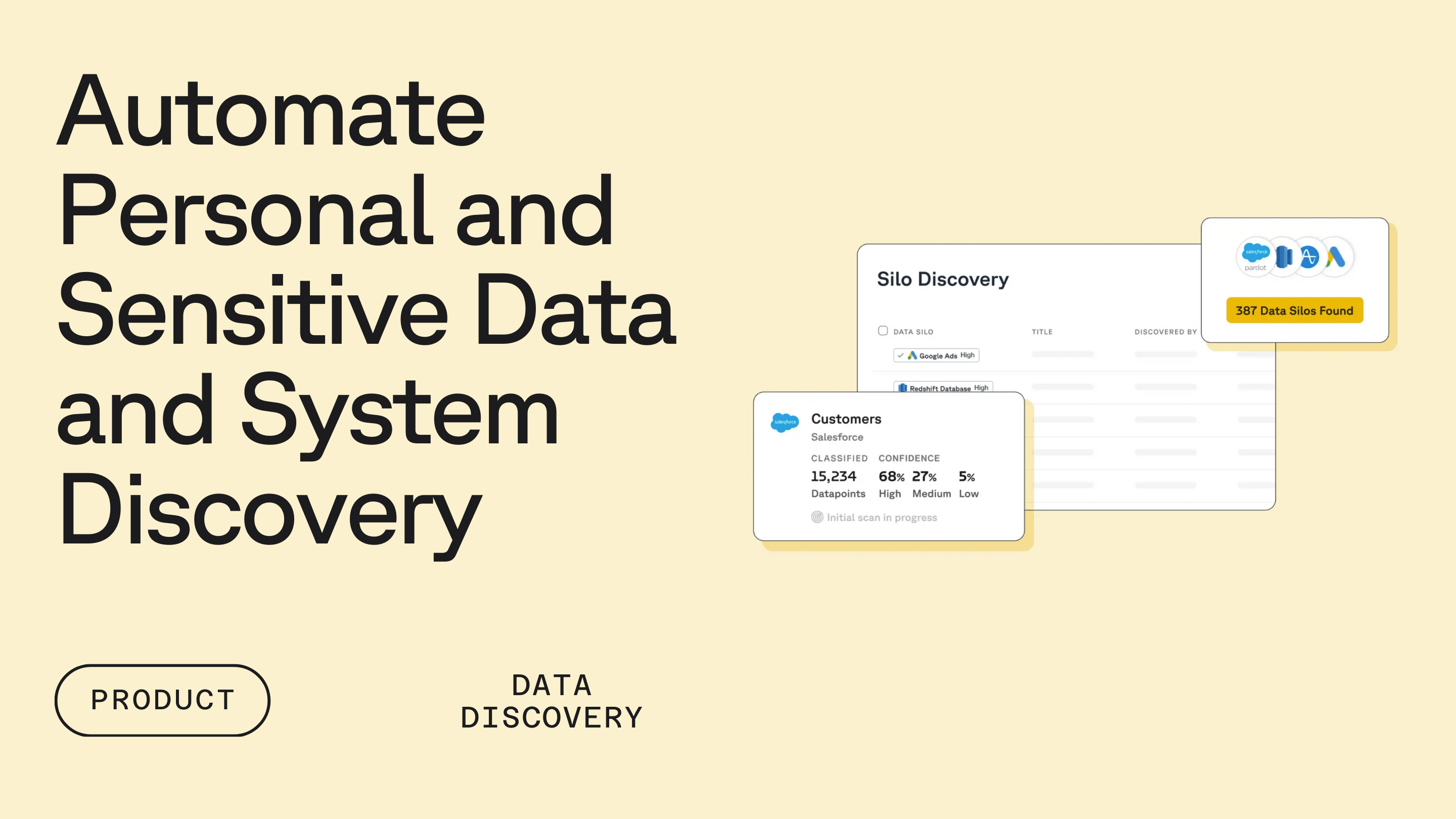
- System Discovery automatically reveals where personal data lives, as well as how third-party vendors govern data and utilize AI, giving enterprises visibility and control over their systems.
- Structured Discovery finds and classifies data down to the column level, all without manual work or traditional heavy deployments.
- Unstructured Discovery enables enterprises to automatically find and govern sensitive data across PDFs, text logs, and other unstructured formats to effectively manage risk and meet compliance.
Once discovered, everything flows into your Data Inventory, the master list of data, systems, and silos across your organization. Together, these capabilities replace fragmented tools and manual audits with a single, continuously updated source of truth for data discovery and governance.
By centralizing visibility across structured and unstructured data, systems, and vendors, Transcend enables teams to understand what data they have, how it’s used, and where risk exists—so governance keeps pace with AI, personalization, and evolving regulation without slowing the business down.
Strategic benefits of comprehensive data visibility
Comprehensive data visibility gives leaders a clear understanding of where data lives, how it’s used, and how it’s governed—enabling faster decisions and lower risk across the enterprise.
- AI initiatives scale more effectively: With clear visibility into data sources and permissions, organizations reduce approval delays and connect AI systems directly to core platforms like CRM and ERP, unlocking stronger returns and more reliable outcomes.
- Personalization improves: Marketing teams can target audiences effectively while also honoring consumers' consent and preference choices. Clear governance eliminates uncertainty around consent and data gaps, driving more relevant experiences and measurable revenue impact.
- Lower risk: By shifting compliance from reactive to operational, risk is reduced across the organization. When data is continuously visible and documented, organizations respond faster to regulatory changes, security incidents, and audits without disrupting the business.
- Increased efficiency: Operational efficiency improves as manual discovery and mapping are replaced with automation. Teams spend less time tracking data and more time delivering value. One Transcend customer had over 1,500 systems mapped, a full data record, and automated DSRs in just 30 days after getting started.
Practical steps to get started
You don’t need a large-scale transformation to get started with automated data discovery. The most effective programs start small, show value quickly, and expand in step with business priorities.
- Start with your core systems: Connect automated discovery to your primary database, CRM, and marketing platforms first. This creates an initial data map quickly, without manual effort, and delivers early visibility that helps teams identify risk, align stakeholders, and build momentum.
- Expand based on risk and impact: Add systems over time, prioritizing those with the highest regulatory exposure or the greatest impact on business outcomes. If AI initiatives are delayed due to unclear data usage or permissions, focus discovery efforts on the data sources feeding those models.
- Automate enforcement alongside discovery: Discovery alone isn’t enough. As new systems are identified, connect them immediately to consent enforcement and data subject request workflows. This ensures governance keeps pace with growth and prevents new data silos from forming.
- Make discovery continuous: Automated data discovery should operate continuously, not as a one-time audit. Regular scanning and refinement keep data maps current as systems evolve, vendors change, and regulations shift—turning visibility into an ongoing operational capability.
Moving forward with automated data discovery
Unknown data silos mean unknown risks. They slow down your AI, make it harder to follow the law, and keep you from making customers happy. Manual data tracking won’t keep up.
Automated discovery fixes that. It gives you live updates on where your data lives and what’s inside, so pursue new strategic campaigns and revenue opportunities with confidence. With the right platform, you’re always ready—AI gets the right training data, marketing can expand their addressable audience, audits are easy, and compliance teams aren't scrambling at the last minute.
The organizations who are winning aren’t the ones with the fewest tools—they’re the ones that can see everything. Check out how Transcend’s automated data discovery helps you find and classify all your data in weeks, not months, and use that insight to get ahead of the competition.


January 23, 2026