Encoded AI governance: The new enterprise imperative
8 min read

"AI governance" has become one of the most overused, least meaningful phrases in enterprise software. Everyone, from hyperscalers to legacy GRC vendors, is putting it on their homepage because the term itself is so vague it can mean almost anything.
For buyers of these services, that vagueness costs time and money. AI agents stall in the pilot stage, personalization campaigns activate against artificially reduced audiences, and models get pulled days before launch because nobody can prove the training data was clean.
Getting AI governance right is the difference between shipped and shelved, and the companies that ship will win.
The crux of the issue is the very real, very meaningful difference between compliance policy and encoded enforcement. Policy documents, model cards, risk registers, and post-hoc audit logs are artifacts of governance. They matter, but only in that they describe intent. They don’t actually govern because they don’t autonomously enforce in runtime.
AI is the first enterprise technology that’s too fast, valuable, and risky to be governed by paperwork. It evolves weekly, creates value daily, and accrues risk in real time. The documentation-based GRC processes that, for SaaS rollouts, were merely slow now actively cost the business in stalled launches and exposed data. This is why governance has to move at the same speed as technology: at runtime, at the point of use.
Defining AI governance for your enterprise
AI Governance is only real if it's enforced at runtime, at the point of data use. True governance means the system mechanically cannot use data it’s not permitted to use. That’s why Transcend calls it Encoded AI Governance.
With that distinction in mind, this is the definition of Encoded AI Governance all CEOs, CISOs, CPOs, CDOs, and CMOs should understand:
Encoded AI Governance is the set of controls that determine what an AI system can do, for what purpose, under what conditions, and on what authority: enforcing user consent, preferences, regulatory constraints, and business rules automatically, in the systems that process the data.
For clarity, let’s dive into each of these components:
1: The What (What data an AI system can use)
Every AI workload (training, fine-tuning, inference, retrieval, agentic actions) draws from a finite set of data. Governance defines, record-by-record and field-by-field, which data is in scope and which is off limits.
2: The Why (For what purpose)
Permissions are purpose-specific i.e. business policies are defined allowing the use of X data for Y purpose. Data a customer allows for service delivery is not automatically available for model training, marketing personalization, or third-party enrichment. Governance binds each piece of data to the purposes it can serve.
3: The When (Under what conditions)
Permissions are not static. They depend on jurisdiction, contract terms, data sensitivity, retention windows, the customer's current consent state, and the AI system's risk classification. Governance evaluates these conditions in real time, not at policy-review time.
4: The Who (On whose authority)
Authority comes from three sources that must be reconciled: the customer (consent and preference), the business (internal rules, contracts, IP protection), and the regulator (GDPR, CCPA, the EU AI Act, sector-specific rules). Governance encodes all three and resolves conflicts deterministically.
5: The How (Enforced automatically at runtime)
Enforcement is not a human reviewing a dashboard, an auditor reading a log after the fact, or an agent following instructions. It is code in the data path that allows or denies the operation at the moment the AI system attempts to use the data. If the system can ignore the rule, the rule is not governance, it's documentation.
6: The Where (In the system where the data is used)
Governance lives inside the systems that actually process data (pipelines, warehouses, feature stores, model APIs, agent runtimes), not upstream at the point of collection and not after the fact in an audit report. The downstream, in-system use is the only place enforcement is real, because it's the only place the system can be physically prevented from using data it’s not permitted to use.
Why Encoded AI Governance is a business imperative
Every enterprise has data governance policies, but almost none are enforced where it actually matters: inside the systems that process customer data. That gap isn't a compliance problem. It's a business problem, and it shows up in revenue, velocity, and risk.
It's why AI initiatives stall in pre-production, while legal and engineering debate over what data the model can use. It's why personalization campaigns launch against half the addressable audience when no system can confirm which customers consented. It's why a model gets pulled days before launch when nobody can prove the training data was clean. Each of those outcomes has a direct cost: slower time to value, smaller activated audiences, abandoned investments, and eroded trust with customers, regulators, and shareholders. Transcend closes that gap.
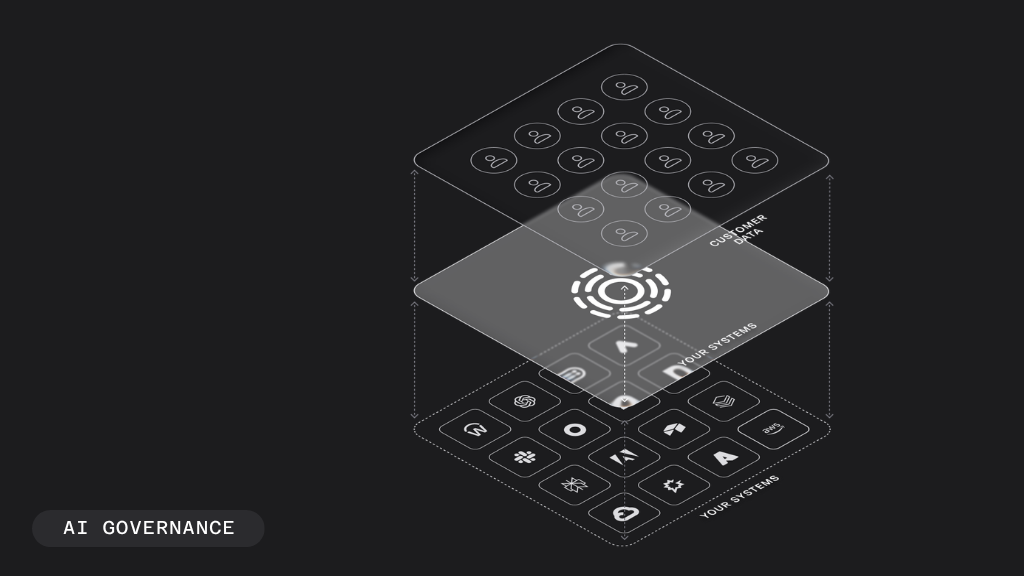
Transcend encodes data-use permissions, like consent, preferences, business rules, and regulatory requirements, directly into the systems that process customer data e.g. the pipelines, warehouses, activation tools, and AI systems where data actually moves.
When a customer updates a preference, every system reflects that change in real time. When an AI agent reaches for a record, it either has permission and can act or it doesn't and can’t. Our proprietary secure-by-design architecture never touches the underlying customer data, so even the most sensitive use cases are unlocked rather than blocked.
This is what AI governance actually requires. And to be clear: enterprises should keep doing the foundational work. Keep a catalog of every AI tool, vendor, chatbot, model, and major workflow. Block the obviously risky use cases. Name a human accountable for AI risk. Train your employees on how to use it well.
None of that is wasted effort, but none of it is governance, either. It's the artifacts of governance: the inventory, documentation, awareness, and policy.
Encoded AI Governance is infrastructure that autonomously makes the right decision at runtime, at the point of use, every time.
When governance is encoded, AI projects ship, audiences activate fully, and models train on data the business can stand behind. The ability to optimize the balance between business value and risk is a competitive advantage.
Transcend is the only autonomous "can I use this data" platform that offers both Encoded AI Governance and turns AI data decisioning into a driver of better business outcomes.
Read the exclusive research on the hidden force behind every stalled enterprise AI initiative
Get the reportWhere to start: Four questions that tell you where you stand
Before evaluating any solution for AI governance, including Transcend, run your current stack through a short diagnostic. These questions cut through the marketing language and surface what's actually happening inside your systems today.
1. Can you confidently answer, “Can I use this data?” When an AI agent pulls a customer record into an analysis, does your governance tool stop it if there is no consent or does it log it afterward? What about the use of credit cards, health data, or other sensitive fields, is access prevented or just recorded?
If the answer is "log it afterward," that's not governance, that's auditing. Auditing tells you what went wrong. Governance prevents it from going wrong in the first place.
2. What percentage of your addressable audience is sitting on the sidelines: not because customers opted out, but because no one can prove what they opted into? And how many quarters has your most recent AI initiative spent stuck in pre-production while legal, data, and engineering reconcile what data the model is allowed to see?
If the honest answer is "more than we'd care to admit" or "we don't actually know," that's not just a governance gap—that's revenue and time-to-market sitting on the wrong side of permission ambiguity. Every customer record your team can't confidently activate is growth being subsidized by uncertainty. Every quarter your AI roadmap spends in legal triage is a quarter your competitors spend shipping.
Real governance frees the business to move. When permissions are deterministic and propagated in real time, your addressable audience becomes your actual audience, and AI initiatives ship on engineering timelines, not legal review timelines.
3. If a permission changes today, e.g. a customer updates a preference, a contract term shifts, a new regulation takes effect, how long before every downstream system (data warehouse, personalization engine, feature store, model pipeline, agent runtime) reflects that change?
If the answer is "days," "weeks," or "we'd have to manually push it," that's not real-time enforcement, that's batch synchronization with a governance label. In the time it takes to propagate, models train on data they shouldn't have and campaigns activate against records that should have been excluded.
4. Does your governance tool stop the data use if the customer has a "Do Not Train" signal? If a regulator or your board asked you to prove, for a specific customer, that their data was not used in any AI workload they didn't consent to, how long would it take to answer and how confident would you be in that answer?
If the answer is "weeks of manual investigation across legal, data, and ML teams" or "we couldn't really prove it, only argue it," that's not governance. That's archaeology, reconstructing what happened from scattered logs and hoping the evidence holds up.
Real governance produces that answer in minutes, with a record-level audit trail tied to the customer's consent state at the moment each AI system used the data. If you can't produce that answer today, the issue isn't your reporting, it's that enforcement never lived in the data path to begin with.
These four questions tend to make the gap between documentation and artifacts versus encoded enforcement very concrete, very quickly.
See how Privacy, Legal & Risk teams move from governance artifacts to encoded enforcement
See the solutionIf you'd like to work through these questions with us, we'd be glad to set up a complimentary consultation.
We’ll help you map your current data-use permissions against where AI is moving inside your business, identify the enforcement gaps, and help you define a path toward governance that scales with your customer growth rather than slowing it down. Whether or not Transcend ends up being the right fit, you'll leave with a clearer picture of what Encoded AI Governance looks like inside your specific environment and what it would take to get there.
Reach out to schedule a working session with our team
Reach out

By Ben Brook
May 19, 2026