Transcend Named a SpaceX Super Intelligence Launch Partner: Scale Your Grok Deployment with Transcend Rails
5 min read

Update, October 22, 2026: SpaceX Super Intelligence introduced its Partner Network today, and Transcend is a SpaceX Super Intelligence Launch Partner. Read SpaceXSI’s announcement.
“We’re thrilled to partner with SpaceXSI to power agent deployments that give enterprises the confidence to build. Enterprises want Grok Build agents doing real work, while CIOs and CISOs need confidence those agents will follow the rules. Transcend Rails determines whether an action is allowed before it runs, enforces company policy, and creates the audit trail.”
Kate Parker, President, Transcend
A coding agent with access to your repositories, CI/CD pipelines and production databases is the most useful agent in the company and the most expensive one to get wrong. That tension is why most enterprises still keep coding agents on a short leash. Either the agent can't touch anything that matters, or it runs on a developer's credentials with a prompt that says "be careful," and nobody can prove afterward what it did. Neither gets agents into production.
In Transcend’s 2026 Customer Data Readiness Report, 81 percent of enterprise IT leaders said they had delayed, scaled back or abandoned at least one AI initiative in the past year, and 93 percent of them pointed to data permission or governance issues.
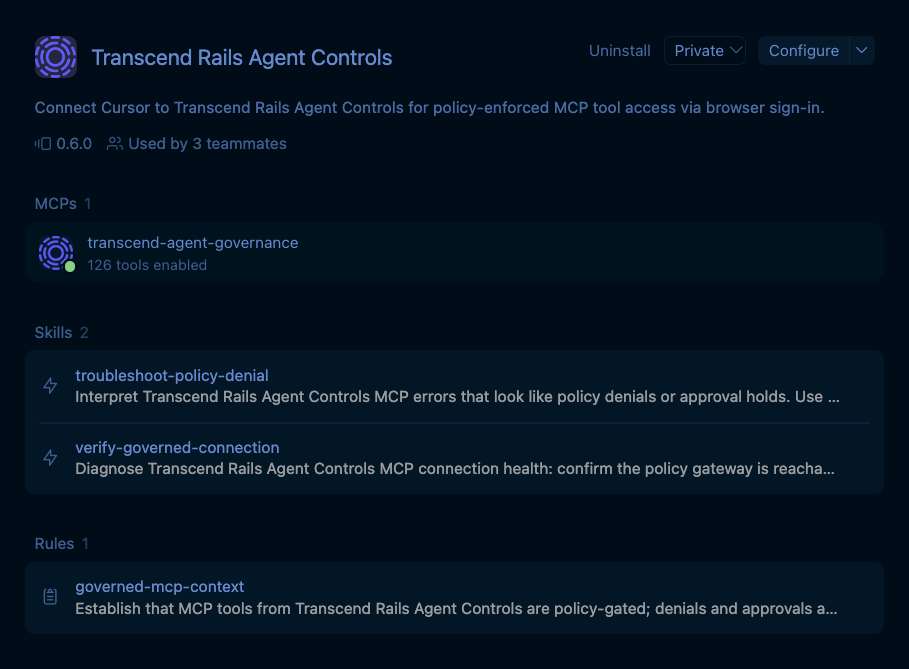
Transcend Rails is the third option. Let the agent in, then decide, action by action, what it is allowed to do once it's there. That option is now one install away for every Grok Build agent. As a SpaceX Super Intelligence launch partner, we built the Transcend Rails Agent Controls plugin so a security team can put a policy check between every Grok agent and every system it touches, without an integration project or a token to manage. Every decision is recorded from the first call.
With the Transcend Rails Agent Controls plugin, every Grok agent gets a policy check before it acts
Your teams write the policies for what an agent can do. Business users write them in plain language, and engineers write them in code. Transcend Rails enforces those policies at runtime and records every decision.
For CIOs and CISOs, that changes the conversation about coding agents. Instead of debating whether they’re ready to trust an agent with production access, they focus on deciding what the agent is allowed to do there, and they can prove the rules were followed. The more you can enforce, the more you can safely let an agent do without a human on every step.

Get the plugin in the Cursor Marketplace
Free to downloadAccess isn't the same as permission
Some teams believe that giving an agent access to the right systems, and keeping it away from the rest, is enough. At Transcend, we don't think it is.
A credential decides which systems an agent can reach. It says nothing about what the agent should do once it's in. If an agent can read the payments repo with a developer's access, it can usually run a migration against the payments database too. Identity tools decide who an agent is, gateways decide what it can reach, and governance platforms document what it should do. None of them sits in the path of the action itself.
An instruction in a prompt ("don't delete customer data") doesn't close that gap, because the agent can ignore it or misread it. A policy checked on every call can't be talked around. That's what the plugin adds, and it moves the question from what an agent can reach to the one that matters: can my agent do this, for this purpose, right now?
Enable and control your agents
- Install and sign in: A developer installs the Transcend Rails Agent Controls plugin from the Cursor Marketplace and signs in with browser OAuth. There's no API token to paste into a config file.
- Register your first agent and policy: Transcend Rails registers a connected agent for the developer, and an administrator assigns the MCP servers it may use and the policies that govern them. The plugin is fail closed by default, so until an administrator grants something, the agent can't call any tool through Rails.
- As the agent runs, every call is checked: Each MCP tool call routes through the Transcend Rails tool gateway and is evaluated before it reaches the upstream server. Every decision resolves to allow, deny or escalate, and an escalated action waits for a named reviewer before it proceeds.
- Record every decision: The audit trail captures the developer, the agent, the tool, the decision and the policy version that produced it, so any action can be reconstructed later. That's becoming a buying requirement, as proof of agent governance starts to show up in enterprise vendor questionnaires.
What a policy looks like in practice
Say your team wants Grok Build agents helping with payments work without ever changing production data. The rule reads like a sentence:
Coding agents may read the payments repository and open pull requests. They may never run migrations against the production payments database.
When the agent tries to run that migration, Transcend Rails stops the call before it reaches the database and returns a decision like this:
{
"decision": "deny",
"reason_code": "PROD_DB_MIGRATION_DENIED",
"policy_version": "bundle-2026-10-05.1"
}
The reason code is stable and readable, so the developer sees why the call stopped and an auditor can trace it later. The policy version is what lets you reconstruct the exact rules in force at that moment.
If you'd rather have a person decide, change the rule to escalate. The action waits for a named reviewer, a timeout resolves to deny, and the agent can never approve its own request. Save escalation for the few actions that matter, like a change to a system of record. An agent that takes a million actions a day and generates ten thousand approval requests just turns your security team into a ticket queue.
The agent knows the rules too
The plugin also gives the agent instructions of its own. It treats a deny or an escalation as a normal outcome of governance and works within it. The agent won't retry hoping the policy changes, won't look for an ungoverned server that offers the same tool, and won't ask the developer for a different credential. If someone asks it to bypass governance, it declines and points them to the administrator.
Know what's covered
Transcend Rails is explicit about which enforcement tier each agent runs at, so nobody assumes coverage they don't have. It works at five enforcement points:
- Tool calls through the tool gateway
- Model calls through the inference gateway
- Outbound network requests through the network gateway
- Memory reads and writes in agent runtimes Transcend Rails provisions
- The decision API, which any agent on any stack can call before it acts
The Grok Build plugin works at the tool gateway. Every MCP tool call routed through Rails is governed, and the decision is applied whether or not the agent cooperates. Tools connected directly to the IDE, beside the gateway, aren't governed, so for an enterprise rollout, connect your MCP servers through Transcend Rails rather than alongside it.
The example above uses a Grok Build agent, but the mechanism doesn't depend on the agent type. Any Grok agent that routes its MCP tool calls through Transcend Rails, including an always-on Grok Bot agent, gets the same policy check and the same audit trail.
Get started
Coding agents are the first agents most enterprises let near production, and they won't be the last. The policy a team writes for its Grok Build agents today is the same policy every other agent runs inside tomorrow, on any stack, with the same owner, the same audit trail and the same kill switch. A CISO who can show what the coding agents did last quarter, and prove the rules were followed, says yes to the next agent faster. That is what this plugin is for. The question stops being whether to let agents into production and becomes how much more to let them do.
Start with one agent and one policy. The first policy is usually a single sentence, like "coding agents may read tickets and may not delete them." Simulate it against last week's traffic, put an owner's name on the agent, and let it do real work.
- Install the Transcend Rails Agent Controls plugin from the Cursor Marketplace.
- Book a technical session at transcend.io to see your Grok Build agents on Rails.